Friday, 10 February 2017

What is a pangolin? Valentine's Day 2017 (Day 1) Google Doodle

Pangolins, often called “scaly anteaters,” are covered in tough, overlapping scales. 

The prehistoric pangolin, which walks on its hind legs due to the length and curvature of its impressive claws

These burrowing mammals eat ants and termites using an extraordinarily long, sticky tongue, and are able to quickly roll themselves up into a tight ball when threatened.

the humble pangolin looks more like an anteater prepped for medieval battle than an animal under threat.

Pangolin species vary in size from about 1.6kg (~3.5 lbs) to a maximum of about 33kg (~73 lbs). 

In response to the pangolin's plight, numerous campaigns have been launched to raise awareness, including the SavePangolins organisation and an app, Roll with the Pangolins, which was endorsed by Prince William in his role as President of United for Wildlife.

They vary in color from light to yellowish brown through olive to dark brown

Sunda pangolin, a species distributed throughout South East Asia, as one of his ten favourite species he would 'save' from extinction.

Unlike African pangolins, Asian pangolins also have thick bristles that emerge from between their scales

There are eight species of pangolin

The search engine Google is showing this playable Doodle for the Day 1 of Valentine's Day 2017 Doodles series.

Tuesday, 31 January 2017

Celebrating Edmonia Lewis Google Doodle


Edmonia Lewis was an American sculptor who worked for most of her career in Rome, Italy.

Born: July 4, 1844, East Greenbush, New York, United States

Died: September 17, 1907, London, United Kingdom

The Search Engine Google will be showing this Doodle in few countries on February 1st for Celebrating Edmonia Lewis

She is the first woman of African-American and Native American heritage to achieve international fame and recognition as a sculptor in the fine arts world.

Her work is known for incorporating themes relating to black and American Indian people into Neoclassical style sculpture.

She emerged during the crisis-filled days of the Civil War, and by the end of the 19th century.

She was the only black woman who had participated in and been recognized to any degree by the American artistic mainstream.

Her father was an Afro-Haitian, while her mother was of Mississauga Ojibwe and African-American descent

Lewis's mother was known as an excellent weaver and craftswoman, while her father was a gentleman's servant.

Her family background inspired Lewis in her later work.

By the time Lewis reached the age of nine, both of her parents had died. Her two maternal aunts adopted Lewis and her older brother Samuel, who was born in 1832.

The children remained with their aunts near Niagara Falls for approximately the next four years.

After college, Lewis moved to Boston in early 1864, where she began to pursue her career as a sculptor.

Lewis was inspired by the lives of abolitionists and Civil War heroes. Her subjects in 1863 and 1864 included some of the most famous abolitionists of her day: John Brown and Colonel Robert Gould Shaw

From 1864 to 1871, Lewis was written about or interviewed by Lydia Maria Child, Elizabeth Peabody, Anna Quincy Waterston, and Laura Curtis Bullard.

For years, the year of Edmonia Lewis's death was speculated to be 1911 in Rome. An alternative view held that she died in Marin County, California, and was buried in an unmarked grave in San Francisco.


Monday, 30 January 2017

Google celebrate Fred Korematsu's 98th Birthday with doodle

Born: January 30, 1919, Oakland, California, United States
Died: March 30, 2005, Marin County, California, United States
Cause of death: Respiratory failure
Spouse: Kathryn Pearson (m. 1946–2005)
Education: Castlemont Community of Small Schools
Parents: Kotsui Aoki, Kakusaburo Korematsu
Children: Karen Korematsu
Today Google’s US homepage is celebrating Fred T. Korematsu, a civil rights activist and survivor of the internment of Japanese Americans during World War II.
January 30th, 2017 would have been his 98th birthday and is officially recognized as Fred Korematsu Day in California, Hawaii, Virginia and Florida.
A son of Japanese immigrant parents, Korematsu was born and raised in Oakland, California. After the U.S. entered WWII, he tried to enlist in the U.S. National Guard and Coast Guard, but was turned away due to his ethnicity.
He was 22 years old and working as a foreman in his hometown when Executive Order 9066 was signed in 1942 by U.S President Franklin D. Roosevelt. The order sent more than 115,000 people of Japanese descent living in the United States to incarceration.
Rather than voluntarily relocate to an internment camp, Korematsu went into hiding. He was arrested in 1942 and despite the help of organizations like ACLU, his conviction was upheld in the landmark Supreme Court case of Korematsu v. United States. Consequently, he and his family were sent to the the Central Utah War Relocation Center at Topaz, Utah until the end of WWII in 1945.
It wasn’t until 1976 that U.S President Gerald Ford formally ended Executive Order 9066 and apologized for the internment, stating "We now know what we should have known then — not only was that evacuation wrong but Japanese-Americans were and are loyal Americans.”

Monday, 23 January 2017

Ed Roberts activist Google Doodle


Edward Verne Roberts was an American activist.

Born: January 23, 1939, San Mateo, California, United States

Died: March 14, 1995, Berkeley, California, United States

Education: University of California, Berkeley

Awards: MacArthur Fellowship

He was the first student with severe disabilities to attend the University of California, Berkeley

 He was a pioneering leader of the disability rights movement

Roberts contracted polio at the age of fourteen in 1953, two years before the Salk vaccine ended the epidemic.

 He spent eighteen months in hospitals, and returned home paralyzed from the neck down except for two fingers on one hand and several toes.

He slept in an iron lung at night and often rested there during the day.

When out of the lung he survived by "frog breathing," a technique for swallowing air using facial and neck muscles.

Ed Roberts is often called the father of the Independent Living movement

In 2017, on his 78th birthday, Roberts was honored with a Google Doodle in recognition of his activism

Ed Roberts is highlighted in Joseph Shapiro's 1993 book, No Pity: People with Disabilities Forging a New Civil Rights Movement.

Roberts died on March 14, 1995, at the age of 56 from cardiac arrest.


Friday, 6 January 2017

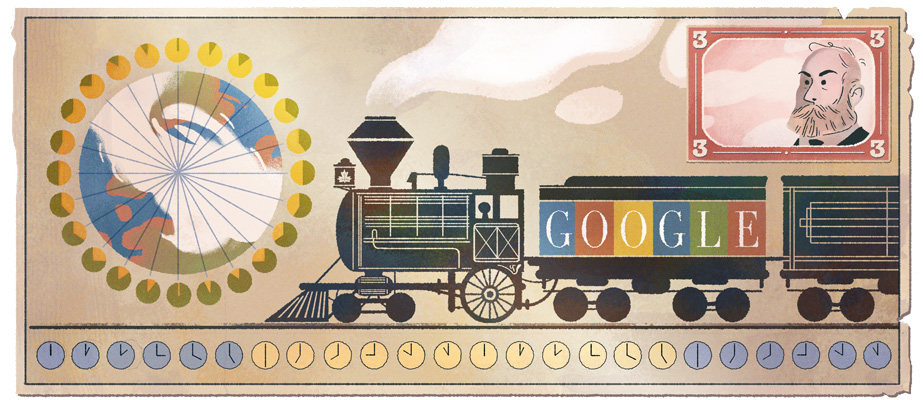
Sandford Fleming’s 190th Birthday Google Doodle

Born: January 7, 1827, Kirkcaldy, United Kingdom
Died: July 22, 1915, Halifax, Canada

Sir Sandford Fleming, KCMG was a Canadian engineer and inventor. Born and raised in Scotland, he emigrated to colonial Canada at the age of 18

It was Ireland in 1876 when a mistake printed in a timetable caused Sandford Fleming to miss his train but alter time as we know it.

Historically, regions used solar time to set their own clocks. It worked well enough until trains came along and the need for standardized time arose, which brings us back to Fleming.

Following his missed train, Fleming—a Canadian inventor and engineer of Scottish birth—proposed a worldwide standard time at a meeting of the Royal Canadian Institute on February, 8, 1879. He advocated for dividing the world into 24 time zones beginning at the Greenwich Meridian and spaced at 15 degree intervals.

His proposal gave way to the International Prime Meridian Conference which convened in 1884 and was attended by 25 nations. It was here that Fleming’s system of international standard time was adopted.

Fleming was also known for helping build the Intercontinental Railway, serving as chief engineer of the Canadian Pacific Railway, and designing Canada’s first postage stamp.


Friday, 30 December 2016

New Year's Day Google Doodle

Happy New Year’s Eve! All across the world tonight.Sharing the eager anticipation of counting down to midnight: 5, 4, 3, 2, 1...
New Year’s Eve Day Facts:
  • New Year’s Eve is one of the favorite celebration days for many people.
  • Around 1 million people will celebrate the arrival of 2017 in Times Square on New Year's Eve.
  • The top three places to celebrate New Year’s Eve are Las Vegas, Disney World and of course, New York City.
  • Internationally, one of the biggest celebrations is in Sydney, Australia. More than 80,000 fireworks are set off from Sydney Harbour Bridge.
  • Time Square New Year's Eve Ball was first dropped in 1907 after there was a fireworks ban.
  • Many Australians annually celebrate New Year’s Eve with parties, music and other forms of entertainment on December 31.
  • New Year’s Eve is the day before New Year’s Day in the Gregorian calendar, which is used by many Australians.
  • Many Australians celebrate New Year’s Eve on boat cruises, urban parklands or beaches.
  • New Year’s Eve is not a public holiday in Australia.
  • New Year's Eve is a major social holiday for many people in the United States.
  • Around the start of the 1900s, New Year's Eve celebrations in America started to appear.
  • The first Ball drop in Times Square was held in 1907
  • Dec 31 Google celebrate New Years Eve Day with animated doodle


Wednesday, 28 December 2016

Charles Macintosh Chemist Google Doodle. Charles Macintosh is the inventor of Raincoat

Born : 29 December 1766 Glasgow
Died : 25 July 1843 (aged 76) Dunchattan
Nationality : Scottish
Charles Macintosh FRS was a Scottish chemist and inventor of waterproof fabrics.
Macintosh was born in Glasgow, the son of George Macintosh and Mary Moore, and was first employed as a clerk.
Macintosh married, in 1790, Mary Fisher, daughter of Alexander Fisher a merchant of Glasgow.
They had one son, George Macintosh (1791-1848)
He Began Working as a Chemist Before He Turned 20 & Was Later Inducted Into the Royal Society for His Discoveries.
He devoted all his spare time to science, particularly chemistry, and before he was twenty resigned his clerkship to take up the manufacture of chemicals.
In this he was highly successful, inventing various new processes. His experiments with one of the by-products of tar, naphtha, led to his invention of waterproof fabric
Charles Macintosh Chemist died in 1843 at Dunchattan, Scotland, and was buried in the churchyard of Glasgow Cathedral.
29th December 2016 The Search Engine Google is showing this animated Doodle in many countries for the Charles Macintosh’s 250th Birthday