Wednesday, 27 April 2016

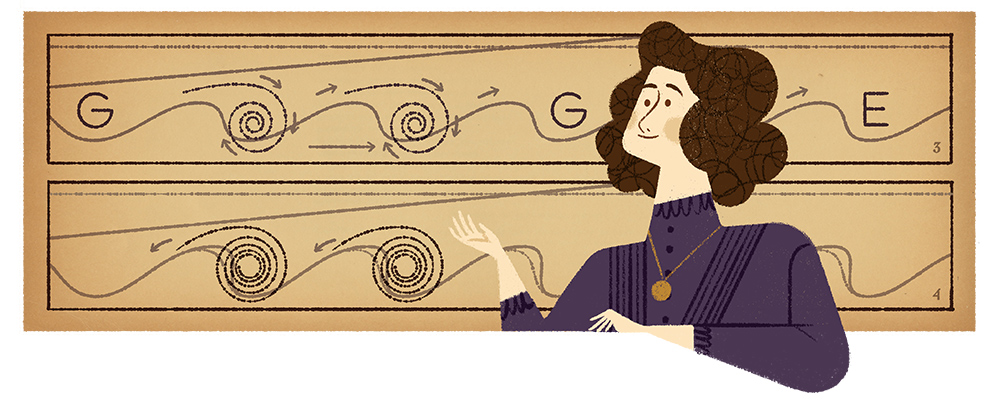
Google Doodle for Hertha Marks Ayrton’s 162nd birthday

Phoebe Sarah Hertha Ayrton was a British engineer, mathematician, physicist, and inventor. She was awarded the Hughes Medal by the Royal Society for her work on electric arcs and ripples in sand and water.

Hertha Ayrton was born Phoebe Sarah Marks at 6 Queen Street, Portsea, Hampshire, England on 28 April 1854. She was the third child of a Polish Jewish watchmaker named Levi Marks an immigrant from Tsarist Poland; and Alice Theresa Moss a seamstress, the daughter of Joseph Moss, a glass merchant of Portsea.

She was first woman to do so. Her words were then published, marking a permanent contribution to the canon of physical science and a victory over discrimination and exclusion.

Today, 162 years after her birth, we celebrate her legacy as engineer, mathematician, physicist, and inventor, her impact still rippling through the scientific community.

She died of blood poisoning (resulting from an insect bite) on 26 August 1923 at New Cottage, North Lancing, Sussex.


Friday, 22 April 2016

William Shakespeare Google Doodle

Genius. There are many examples throughout human history, but today we celebrate one particularly brilliant one: William Shakespeare— writer, playwright, and one of the most eloquent voices of all time. 

Born: April 1564, Stratford-upon-Avon, United Kingdom
Died: April 23, 1616, Stratford-upon-Avon, United Kingdom

He is often called England's national poet, and the "Bard of Avon".Shakespeare produced most of his known work between 1589 and 1613.His early plays were primarily comedies and histories, and these are regarded as some of the best work ever produced in these genres.

 He then wrote mainly tragedies until about 1608, including Hamlet, Othello, King Lear, and Macbeth, considered some of the finest works in the English language.Today the Search Engine Google is showing a Doodle for marking 400th death anniversary of William Shakespeare.

Shakespeare was an English poet, playwright, and actor, widely regarded as the greatest writer in the English language and the world's pre-eminent dramatist. He is often called England's national poet.

William Shakespeare officially wrote 38 plays in his 52 years, some of which you can spot in today's Doodle. Can you identify all of them? 


Wednesday, 6 April 2016

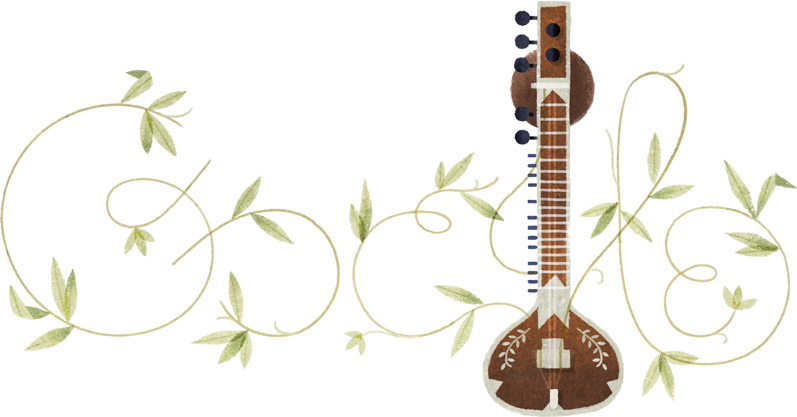
Pandit Ravi Shankar’s 96th birthday Google Doodle

Today we celebrate Pandit Ravi Shankar, who was born 96 years ago today. Shankar evangelized the use of Indian instruments in Western music, introducing the atmospheric hum of the sitar to audiences worldwide.

He performed frequently with the violinist Yehudi Menuhin, and composed a concerto with sitar for the London Symphony Orchestra. Shankar also taught George Harrison of the Beatles how to play the sitar, and widely influenced popular music in the 1960s and 70s.

In 1956 he began to tour Europe and the Americas playing Indian classical music and increased its popularity there in the 1960s through teaching, performance, and his association with violinist Yehudi Menuhin and Beatles guitarist George Harrison. His influence on the latter helped popularize the use of Indian instruments in pop music throughout the 1960s.


Tuesday, 5 April 2016

First Modern Olympic Games at Athens in 1896. Google shows Doodle for 120th Anniversary.

Today is the 120th anniversary of the first modern Olympic games, which started in Athens, Greece in 1896. Officially called the Games of the I Olympiad, the events took place inside the Panathenaic Stadium.
The Search Engine Google is showing a Doodle for marking this event.

It was the first international Olympic Games held in the Modern era. Because Ancient Greece was the birthplace of the Olympic Games, Athens was considered to be an appropriate choice to stage the inaugural modern Games.

Despite many obstacles and setbacks, the 1896 Olympics were regarded as a great success. The Games had the largest international participation of any sporting event to that date. 

The 1896 games included 9 different sports and 43 events. Most noteworthy was the marathon — it had the greatest number of international athletes ever.

 Equally noteworthy was its winner, Spyridon "Spyro" Louis, the only Greek champion in the athletics division, and a national hero for the host country. His monumental victory on that historic day continues to inspire Greek pride.


Tuesday, 8 March 2016

Google Doodle for Clara Rockmore’s 105th Birthday

Today( Mar 9, 2016) the Search engine Google is showing an interactive animated Doodle for the 105th Birthday of Clara Rockmore.
Clara Rockmore was a Lithuanian expert performer of the theremin, an electronic musical instrument.
Rockmore was a child prodigy on the violin and entered the Saint Petersburg Conservatory at the age of five. She remains to this day the youngest student ever to be admitted to the institution.
Unfortunately, bone problems due to childhood malnutrition forced her to abandon violin performance past her teen years. That however led her to discover the newborn electronic instrument and arguably become the greatest ever virtuosa of the theremin.
She died in New York City on May 10, 1998, at age 87.

Sunday, 28 February 2016

Why is there a Leap Day? Google Shows Doodle for Leap Year 2016

Today's (29th February 2016) Google Doodle celebrates Leap Day! Why is there a Leap Day? Google Shows Doodle for Leap Year 2016
The 29th of February only happens every four years. This is to keep our calendar in sync with the rotation of the Earth around the sun. Without Leap Day, we'd be out of sync by about six hours per year. 
Leap Day happens every four years unless that year is divisible by 100. If you were around in 1900, you would have missed out on the magic of February 29. 
Anyone born on Leap Day, will not get chance to celebrate their birthday every year.


Sunday, 7 February 2016

Dmitri Mendeleev Google Doodle.182nd Birthday of Father of the Periodic Table

Today (8th February, 2016) the Search Engine Google is showing a Doodle for the 182nd Birthday of Dmitri Mendeleev in many countries.

Dmitri Mendeleev was a Russian chemist and inventor. He formulated the Periodic Law, created his own version of the periodic table of elements, and used it to correct the properties of some already discovered elements and also to predict the properties of eight elements yet to be discovered.

Around 400 BC, the ancient Greeks organized the worldly elements into four groups: air, water, earth, and fire. In the seventeenth century, Robert Boyle explained the material world in terms of elements, mixtures, and compounds. And in 1869, Dmitri Mendeleev made sense of the 56 elements known at the time, showing how they related to each other in a distinct pattern. His periodic table let elements fall into "periods" according to atomic mass and valence (the power that determines how they combine). 

Scholars had attempted to organize the elements into a table before, but Mendeleev's work extended beyond mere chart-making. Mendeleev used the logic of his table to argue for the existence of yet-to-be discovered elements (like gallium and germanium), and even to predict their behaviors. Some of these predictions were wrong, but the basic principles behind his periodic organization continue to stand at the foundation of modern chemistry. The periodic table of the elements (now with 118 elements and counting) adorns science classrooms worldwide.
Watch This video below